Solar Panels
The old site recorded a steep fall in panel prices. That historical change made photovoltaic desalination practical in more locations; this archive does not make a new price forecast.


Reverse Osmosis Powered By The Sun
For more than fifteen years, Sisyan LLC designed and optimized seawater photovoltaic reverse-osmosis plants in Baja California Sur, Mexico.
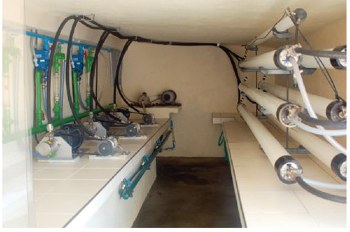
This site is a record of that work: the pilot systems, the engineering drawings, and Yan Kunczynski and Ben Burger's original paper on demand-response desalination.
The work is presented as a technical archive, not as an active sales or project-development program.
The original case
A 40% gap between freshwater supply and demand was predicted by 2030, and the stress on natural water systems could already be seen in every part of the world.
In addition to water recycling and conservation, new sources would be necessary. Seawater is the only source that is drought-proof and virtually inexhaustible.
Purifying seawater is also the most energy-intensive way to provide freshwater. The white paper reported that desalinated water typically cost four to eight times more to produce than other sources, with energy often accounting for more than half of operating cost.
Three claims in the paper
Language and figures in this section come from page 2 of Demand Response Desalination (2015). They are retained as the paper presented them, not recast as current projections.
As climate change contributes to water shortages, fossil fuels are not part of the solution.
The economics, as the original site explained them
The old site recorded a steep fall in panel prices. That historical change made photovoltaic desalination practical in more locations; this archive does not make a new price forecast.
Lead-acid batteries once accounted for around 60% of the cost of off-grid solar desalination. Storage was therefore a central design and cost constraint.
RO had achieved steady efficiency improvements, but further gains were approaching limits imposed by physics.
Renewable generation was getting less expensive, while the electric grid still required substantial adaptation and investment.
From the original white paper
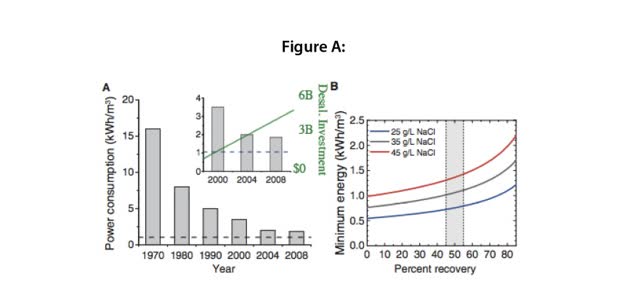
Figure A places the historical fall in reverse-osmosis power consumption beside the thermodynamic minimum at different salinities and recovery rates. It is reproduced from the paper rather than redrawn from estimated data.
The technology
Membrane-based pretreatment (0.03-micron ultrafiltration) protects and extends the life of the RO components, and allows brine streams to be blended — significantly reducing the salinity of what returns to the sea.
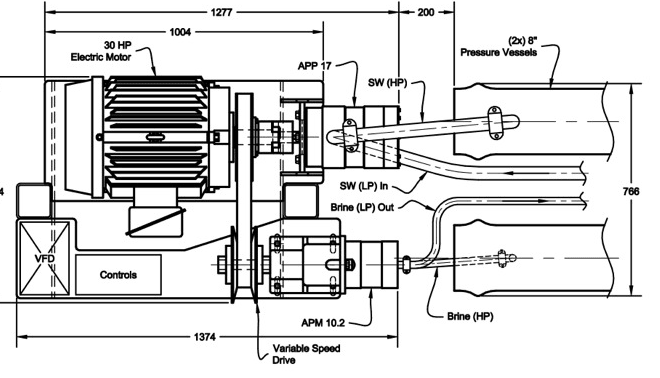
Unique to this application, the variable frequency drives accept DC current directly from the solar array and batteries — eliminating expensive inverters and creating a naturally flexible, dispatchable load.
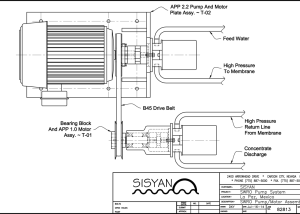
The most efficient positive-displacement high-pressure pump available — light, low-maintenance, and well matched to variable solar input.
An axial-piston motor recovers the pressure still held in the brine stream after desalination and applies it directly to the torque of the pump shaft — one of the first uses of paired APP/APM energy recovery.
A purely mechanical process that pushes fresh water through a semi-permeable membrane while the cross-flow of brine carries dissolved solids away — no heat, no phase change.
The central proposal
The paper proposed replacing large pressure centers with a multitude of relatively small, fully integrated RO modules.
The plant could coordinate production with energy prices by automating the number of modules in operation. The design grew directly from Sisyan's off-grid pilot, where modules switched on and off in response to battery voltage and available sunlight.
Reverse-osmosis plants are suited to flexible operation because they are not labor-intensive, seawater is continuously available, and treated water can be stored. The claim was specific: make the electrical load adjustable without asking water demand to become adjustable.
Read the paper onlineThe grid problem
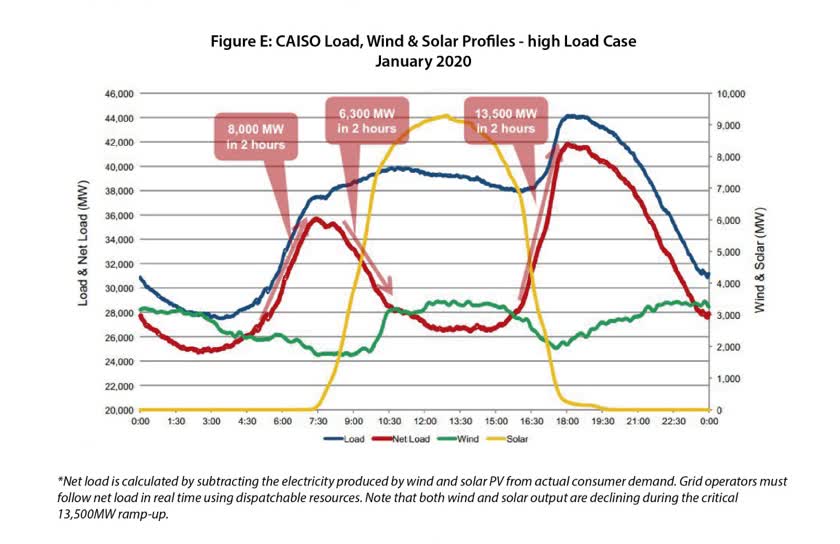
The paper used this CAISO simulation to show the steep ramps a high-renewable grid must follow. It does not claim that desalination output traces an invented hourly curve.

About
Yan was the founder and creative force behind Sisyan, with more than fifty years of experience designing, manufacturing, and deploying original machines.
He was a licensed California contractor “A” from 1963 and filed more than twenty patent applications. Before turning his attention to water, he was best known for his contributions to aerial tramways and automatic people movers.
The clearest account of how he worked is his own: define the objective, think independently, prototype and test, then simplify.
Read Yan's points on design