
Demand Response Desalination
The 2015 proposal for coordinating reverse-osmosis production with energy conditions by changing the number of modules in operation.
Download the white paper (PDF)The 2015 paper presented a way to design and operate reverse-osmosis desalination plants using a multitude of relatively small, fully integrated RO modules in place of large pressure centers. It proposed coordinating production with energy prices by automating the number of modules in operation, with the goals of reducing operating cost and providing demand response.
Desalination will be necessary
A 40% gap between freshwater supply and demand is predicted by 2030, and the stress on natural water systems is already visible everywhere. Beyond recycling and conservation, new sources are needed — and seawater is the only one that is drought-proof and virtually inexhaustible. But purifying it is the most energy-intensive way to make fresh water: desalinated water typically costs four to eight times more to produce than other sources, with energy often more than half of the operating cost.
Further efficiency gains are limited
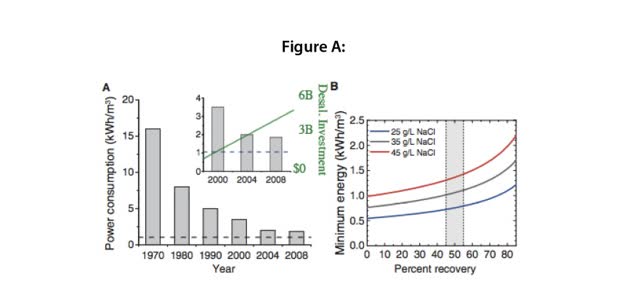
Reverse osmosis has led the field through more than sixty years of advances, but every method of desalination is bound by the laws of thermodynamics — a minimum energy is required to separate pure water from dissolved salt. As the process approaches that floor, the room to improve shrinks. Too much attention and money now goes into marginally better membranes, pumps, and energy-recovery devices, and not enough into integrating water production with the availability of cheap energy.
Electricity is cheaper than ever — but not always
Like any commodity, electricity is cheap when demand is low: nights, weekends, and whenever only the least-expensive generators are running. But the cheapest generators — coal and nuclear — are inflexible and cannot easily cycle off. When there's a surplus, wholesale prices fall until output drops, sometimes going negative: it can be cheaper to pay a grid operator to take excess energy than to shut a plant down and restart it.
Renewables intensify the peaks and valleys
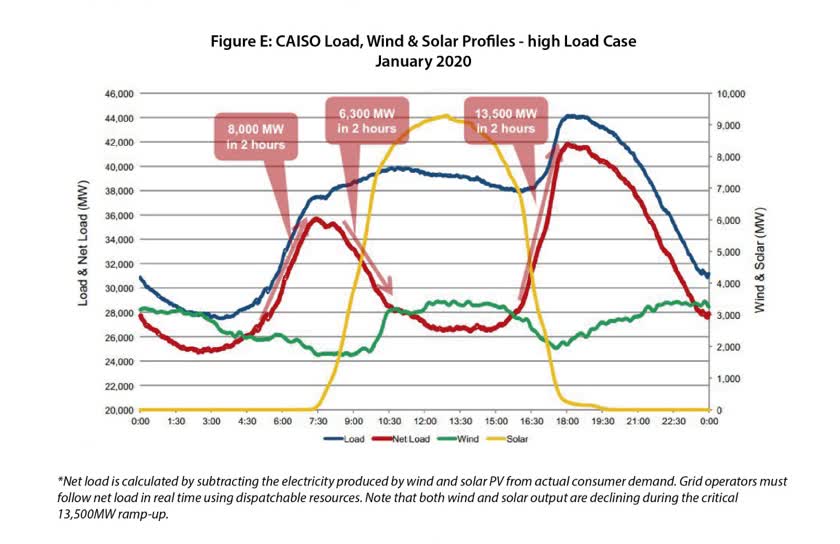
Wind and solar have no fuel cost and their output can't be dispatched. Solar peaks too early for peak demand; wind often blows hardest at night when demand is lowest. This drives the steep 'net-load' ramps that grid operators must chase with expensive, fast-responding plants — and creates some of the most volatile wholesale markets on record. Weather extremes have pushed prices to 60 and even 86 times their normal levels.
Flexible users will be rewarded
Those costs are increasingly passed to consumers through time-of-day pricing — a form of demand response. Regulators have ruled that demand-response resources be paid the wholesale market price when they're used, and NREL models show demand response could supply 85% of the flexibility reserves a high-renewable grid needs. The challenge is finding enough energy users suited to flexible operation.
Reverse osmosis is an ideal candidate
RO plants are ideal for demand response: they're not labor-intensive, seawater is always available, and treated water is easily stored. The catch is that most plants today use very large pumps with a narrow operating range — they demand constant power exactly when flexibility matters most.
Demand Response Desalination
Designing a plant with an adaptable energy demand is the obvious answer. Applying more than fourteen years of continuous research desalting seawater with the sun — an intermittent source — the design uses many independent modules, each switched on or off to hit the plant's target energy load. A pilot on the Sea of Cortez proved it: built between 2000 and 2004, it is believed to be the first continuous-production photovoltaic seawater reverse osmosis (PV-SWRO) system to use paired axial-piston pump and motor (APP/APM) for both high pressure and energy recovery.
The pilot runs three 3 hp modules sharing a beach well, ultrafiltration, storage, a solar array and a battery bank. Over more than twelve years it has produced over 68,000 m³ — 18 million gallons — of permeate below 300 TDS from 33,000 TDS seawater, on solar energy alone. Adding ultrafiltration nearly doubled the service life of the pumps and membranes.
Scaling up: the grid-integrated design
The same mechanical and hydraulic principles scale to larger 30 hp modules. A demand-response plant would use anywhere from 5 to 500 of them, adjusting energy demand in roughly 22 kW increments — a practically stepless load that can absorb sudden losses from renewable or conventional generators, and earn revenue for grid services like frequency regulation and contingency reserve.
Conclusion
In 2014 the UN, the White House, and the World Economic Forum each concluded that water and energy are so intertwined that only coordinated approaches can solve either. By aligning their energy profile with the grid's availability, RO plants can be integrated with the grid in a mutually beneficial way. Without flexible operation, desalination plants are fragile to today's energy trends. A multi-module plant can lower the cost of desalination, expand the use of renewable energy, and play an essential role in balancing the grid.
Desalting water with renewable energy = energy storing
Three claims in the paper
Why the water-energy problem mattered
From the original white paper
Further energy reductions are limited
Figure A places the historical fall in reverse-osmosis power consumption beside the thermodynamic minimum at different salinities and recovery rates. It is reproduced from the paper rather than redrawn from estimated data.
The grid problem
Load, net load, wind and solar do not move together
The paper used this CAISO simulation to show the steep ramps a high-renewable grid must follow. It does not claim that desalination output traces an invented hourly curve.
Calculated from the proposed module
A plant adjustable in approximately 22 kW steps
The paper envisioned plants containing 5-500 independently controlled modules. Every additional module would add or remove about 22 kW of load.