Membrane pretreatment
Membrane-based pretreatment (0.03-micron ultrafiltration) protects and extends the life of the RO components, and allows brine streams to be blended — significantly reducing the salinity of what returns to the sea.

The technology
Photovoltaic seawater reverse osmosis, explained from the original site and the 2015 paper.
The process
A beach well draws seawater through the sand itself — a natural first filter that protects everything downstream.
0.03-micron membranes clarify the feed, extending RO membrane life and letting brine streams be blended to lower discharge salinity.
An axial-piston pump (APP) — the most efficient positive-displacement pump available — is driven directly by DC solar through a variable frequency drive.
Seawater is pushed through semi-permeable membranes at ~680 psi. Fresh water passes through; the cross-flow of brine carries dissolved salts away. No heat, no phase change.
An axial-piston motor (APM) captures the pressure still held in the brine and returns it directly to the pump shaft — one of the first uses of paired APP/APM recovery.
Permeate below 300 TDS is stored for use day or night; blended brine returns to the sea at reduced salinity. Sunlight in, fresh water out.
Measured water quality
The logarithmic scale keeps both measured concentrations legible. The permeate contained less than 0.91% of the feed-water TDS.
Reported TDS value (logarithmic scale)
Measured T-1 module flow
The paper identifies 33% as the most cost-effective measured yield for the pilot.
Where the leverage is
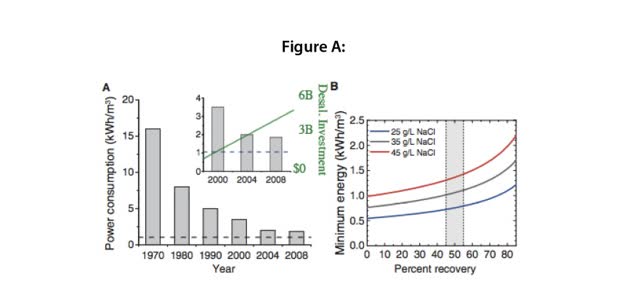
The paper argued that reverse osmosis had already benefited from more than sixty years of technical improvement and that every desalination process remains bounded by the thermodynamic minimum required to separate water from salt.
Its conclusion was cautious: as the process approaches that minimum, opportunities for further efficiency improvements decline. More attention should therefore be paid to coordinating water production with the availability of inexpensive energy.
From the original white paper
Figure A places the historical fall in reverse-osmosis power consumption beside the thermodynamic minimum at different salinities and recovery rates. It is reproduced from the paper rather than redrawn from estimated data.
Core technologies
Membrane-based pretreatment (0.03-micron ultrafiltration) protects and extends the life of the RO components, and allows brine streams to be blended — significantly reducing the salinity of what returns to the sea.
Unique to this application, the variable frequency drives accept DC current directly from the solar array and batteries — eliminating expensive inverters and creating a naturally flexible, dispatchable load.
The most efficient positive-displacement high-pressure pump available — light, low-maintenance, and well matched to variable solar input.
An axial-piston motor recovers the pressure still held in the brine stream after desalination and applies it directly to the torque of the pump shaft — one of the first uses of paired APP/APM energy recovery.
A purely mechanical process that pushes fresh water through a semi-permeable membrane while the cross-flow of brine carries dissolved solids away — no heat, no phase change.
Why modularity mattered
A conventional plant usually operates large pumps within a narrow range. The proposed modular plant changed demand by changing the number of modules in operation.
Calculated from the proposed module
The paper envisioned plants containing 5-500 independently controlled modules. Every additional module would add or remove about 22 kW of load.